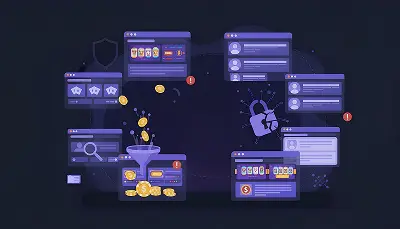
Detecting promo abuse requires monitoring multiple signal layers: behavioral analytics to identify bot-like interaction patterns, account analysis to spot fake or duplicate registrations, network analysis to detect proxy and datacenter traffic, and transaction monitoring to flag suspicious redemption velocity. This guide covers how promotional fraud works, the five most common abuse types, their business impact, and the detection and prevention strategies organizations need to protect their marketing investments.
Promotional campaigns designed to attract new customers and reward loyal ones have become prime targets for sophisticated fraud operations that can drain marketing budgets and destroy campaign effectiveness within hours. This comprehensive guide examines how promo abuse works, the devastating impact it has on businesses, and the defensive strategies you need to protect your business from fraudsters exploiting your promotional offers.
What Is Promo Abuse Fraud?
Promo abuse fraud occurs when bad actors systematically exploit promotional offers, discounts, referral programs, and loyalty rewards for financial gain, using methods that violate terms of service and undermine the intended purpose of these campaigns. This type of fraud has evolved from isolated incidents of coupon misuse to organized operations employing bot traffic, fake accounts, and sophisticated technical methods to abuse promotions at massive scale.
The scope of promotional fraud extends across every industry offering incentives to customers. E-commerce platforms lose millions to fake accounts claiming new user discounts repeatedly. Food delivery services see their referral programs exploited by fraud rings creating thousands of fake accounts. Gaming companies watch bonus credits disappear to bot networks. Subscription services face waves of trial abuse from users who never intend to pay. Financial services see their signup bonuses harvested by professional fraudsters using synthetic identities.
Modern promo abuse represents a fundamental shift in fraud methodology. Rather than stealing existing value through traditional fraud, these operations extract value directly from marketing budgets designed to drive growth. Fraudsters view promotional offers as exploitable vulnerabilities, developing specialized tools and techniques to maximize extraction before detection. The asymmetric nature of this threat — where attackers need only find one weakness while defenders must protect every promotion — creates significant challenges for businesses.
Common Types of Promo Abuse
Understanding the various forms of promotional fraud helps organizations recognize vulnerabilities and implement appropriate defenses. Each type of promotion abuse requires different detection and prevention strategies.
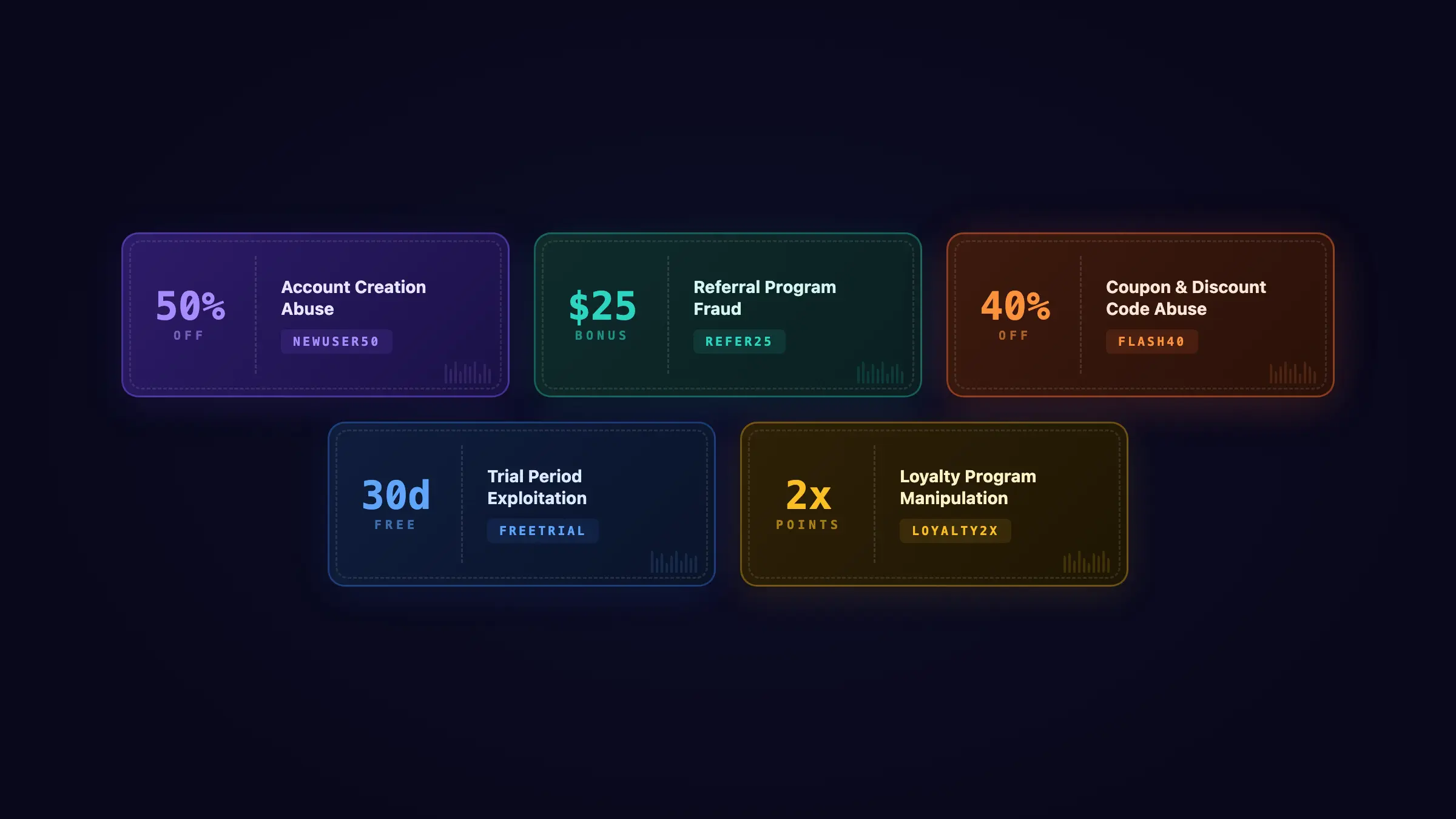
Account Creation Abuse
Fraudsters engage in fake account fraud to repeatedly claim new user benefits, welcome bonuses, and first-purchase discounts. Sophisticated operations rely on:
Residential proxies to mask IP addresses
Virtual phone numbers for verification
Stolen or synthetic identities to bypass KYC and verification checks
Thousands of aged accounts that appear legitimate to screening systems
The economic model is simple: if a new user bonus is worth $10 and creating an account costs $0.50 in resources, the fraud becomes highly profitable at scale.
Referral Program Fraud
Referral programs designed to incentivize organic growth become targets for organized fraud schemes. Common tactics include:
Self-referral — creating both referrer and referee accounts to claim bonuses
Distributed referrals across multiple accounts and time periods to avoid velocity checks
Bot networks that automate the entire process, from account creation through referral completion
Selling referral services to legitimate users, creating a gray market that undermines program integrity
Coupon and Discount Code Abuse
Limited-use promotional codes get distributed through unauthorized channels, shared on coupon aggregator sites, or exploited through technical vulnerabilities. Fraudsters use browser automation to test thousands of code combinations, looking for valid but unpublished discounts. Some operations reverse-engineer code generation algorithms to create unlimited valid codes. Others exploit poorly configured promotions that stack unintended discounts, turning profitable transactions into losses. As coupon fraud scales through automation, businesses face compounding losses from both direct discount abuse and the operational cost of investigation.
Trial Period Exploitation
Free trial offers designed to showcase product value become targets for serial abusers who never intend to convert to paying customers. Fraudsters use virtual credit cards that pass initial validation but fail on actual charging. Others exploit grace periods and refund policies to extend trials indefinitely. Subscription services face particular challenges with users creating new accounts every trial period, accessing premium content without ever paying.
Loyalty Program Manipulation
Points, miles, and rewards meant to encourage repeat business get harvested through fake transactions, manufactured spending, and account takeovers. Fraudsters exploit program rules to generate rewards disproportionate to actual spending. Some operations involve complex chains of transactions designed to maximize point accumulation while minimizing costs. The secondary market for stolen loyalty rewards makes bonus abuse particularly profitable, attracting organized fraud operations that exploit program rules systematically.
How Does Promo Abuse Affect Your Business?
The damage from promotional fraud extends far beyond direct financial losses, creating cascading effects throughout your organization that can threaten long-term sustainability and growth potential.
Financial Losses
Direct costs from promo abuse include the value of stolen promotions, discounts given to fraudsters, and rewards claimed illegitimately. However, these obvious losses represent only part of the financial impact. Marketing budgets get depleted without generating genuine customer acquisition. Customer acquisition costs (CAC) become distorted, making it impossible to accurately assess campaign effectiveness. The opportunity cost of promotions consumed by fraudsters instead of legitimate customers reduces overall campaign ROI. Infrastructure costs increase as systems must handle bot traffic and fake account creation attempts.
Brand Reputation Damage
When legitimate customers cannot access promotions because fraudsters have exhausted limits or when they encounter friction from anti-fraud measures, brand perception suffers. Social media amplifies complaints about unavailable promotions or difficult redemption processes. Competitor advantage grows when customers perceive your promotions as less accessible or valuable. The loss of trust from customers who feel the company cannot manage promotions fairly creates long-lasting negative associations that affect future campaign participation.
Operational Disruption
Promo abuse creates substantial operational burden across multiple departments. Customer service teams become overwhelmed with complaints about promotion availability and account verification issues. Fraud investigation teams spend countless hours reviewing suspicious accounts and transactions. Marketing teams must constantly adjust campaigns to address exploitation. IT resources get diverted to implementing emergency fixes and security measures. Finance teams struggle with reconciliation and chargeback management. This operational strain reduces efficiency and diverts resources from growth initiatives.
Data Contamination
Fake accounts and fraudulent transactions corrupt business intelligence, making data-driven decisions unreliable. Customer segmentation becomes meaningless when significant portions of the user base are fraudulent. Lifetime value calculations get skewed by accounts that will never generate legitimate revenue. A/B testing results become invalid when bot traffic influences metrics. Predictive models trained on contaminated data produce inaccurate forecasts.
How Do Fraudsters Execute Promotion Abuse
Technical Infrastructure
Fraudsters invest in substantial technical infrastructure to execute promotional abuse at scale:
Residential proxy networks providing thousands of IP addresses that appear legitimate to geographic and reputation checks
Browser automation frameworks like Puppeteer and Selenium for scripting complex user journeys
Headless browsers for rapid parallel execution of thousands of sessions
Virtual machine farms providing isolated environments for each fake account
Third-party scripts and tools specifically designed for promo abuse, readily available on underground forums
Synthetic identities combining real and fake information that pass basic verification checks
Stolen identity data from breaches providing genuine details for high-value promotions
Virtual phone number services enabling SMS verification for thousands of accounts
Temporary email services or catch-all domains providing unlimited email addresses
Aged social media profiles and online histories to create more convincing identities
Operational Patterns
Successful promo abuse operations follow systematic patterns designed to maximize profit while avoiding detection. Initial reconnaissance identifies vulnerable promotions and tests detection systems with small-scale attempts. Gradual scaling increases volume slowly to avoid triggering alerts. Time distribution spreads activity across days or weeks to appear organic. Geographic distribution uses proxies to simulate users from multiple locations. Behavioral mimicry attempts to replicate legitimate user patterns. Money laundering through gift cards, cryptocurrency, or electronic transfers converts promotional value to cash.
How to Detect Promo Abuse?
To detect promo abuse effectively, organizations need multiple overlapping approaches that analyze different aspects of user behavior, account characteristics, and transaction patterns.
Behavioral Analytics
Legitimate users exhibit natural variations and imperfections in their interactions that fraudsters struggle to replicate at scale. Navigation patterns show exploration, hesitation, and learning curves that bots cannot perfectly mimic. Time spent on pages varies based on content consumption rather than scripted delays. Mouse movements and scrolling behaviors follow natural human patterns with acceleration and deceleration. Form filling shows corrections, tab navigation, and copy-paste behaviors typical of real users. Advanced behavioral analysis systems build baselines of normal activity and flag deviations suggesting automation or fraudulent intent.
Account Analysis
Examining account characteristics reveals patterns indicating fake or compromised accounts. Registration velocity from similar sources suggests coordinated creation. Email domain analysis identifies temporary or suspicious providers. Phone number patterns reveal VOIP or virtual number usage. Payment method analysis shows prepaid cards or virtual credit cards commonly used in fraud. Social graph analysis identifies isolated accounts lacking normal relationship patterns. Account aging patterns reveal clusters of accounts created in preparation for future campaigns.
Network Analysis
Bot management systems must analyze network-level indicators to identify coordinated fraud campaigns. IP reputation scoring identifies proxy services, VPNs, and hosting providers. Geographic velocity checks detect impossible travel patterns between transactions. Device fingerprinting reveals multiple accounts from identical hardware. Browser fingerprinting identifies automation frameworks and headless browsers. TLS fingerprinting can help identify bot frameworks and scripting tools. Connection patterns reveal coordinated activity from distributed infrastructure.
Transaction Monitoring
Analyzing promotion usage patterns helps identify abuse. Velocity analysis detects rapid redemption suggesting automation. Value extraction patterns show accounts maximizing promotional value while minimizing legitimate purchases. Redemption timing analysis reveals coordinated campaigns. Cross-promotion analysis identifies accounts systematically exploiting multiple offers. Conversion analysis shows accounts that never transition to profitable customers. These patterns, combined with machine learning models, enable real-time detection of promotional fraud.
Detection Layer
What It Analyzes
Key Signals
Behavioral Analytics
User interaction patterns
Navigation, time on page, mouse movements, form filling
IP reputation, device/browser fingerprinting, TLS fingerprint
Transaction Monitoring
Promotion usage patterns
Redemption velocity, value extraction, cross-promotion analysis
How to Prevent Promotion Abuse?
Protecting your promotional campaigns requires a comprehensive strategy that balances security with user experience while maintaining the marketing effectiveness of your offers.
Design Secure Promotions
Building fraud resistance into promotional design reduces exploitation opportunities. Implement progressive verification requirements that increase with promotional value. Use unique, time-limited codes that cannot be shared or reused. Require account aging before eligibility for high-value promotions. Tie promotions to verified payment methods or identity verification. Implement cooling-off periods between promotional redemptions. Design promotions that require genuine engagement rather than simple account creation. Consider behavioral requirements that are difficult for bots to fulfill efficiently.
Implement Multi-Layer Verification
Phone number verification using SMS or voice calls filters out a portion of basic fake accounts, though VOIP and virtual numbers remain a challenge. Email verification with domain reputation checking identifies suspicious providers. Identity verification through document upload or third-party services prevents synthetic identity use. Payment method verification confirms legitimate financial instruments. Social proof verification through existing account connections identifies isolated fake accounts.
Deploy Real-Time Bot Management
Advanced bot management solutions like BotBye provide essential protection against automated promo abuse. Our platform analyzes hundreds of signals in real-time to identify and block bot traffic before it can exploit promotions. Our detection engine analyzes large volumes of interactions to uncover sophisticated fraud patterns. Behavioral biometrics help distinguish genuine users from automated scripts. Device intelligence identifies attempts to mask or spoof identity. Risk scoring enables dynamic response based on threat level. This comprehensive protection significantly reduces successful abuse before redemption while maintaining a smooth experience for legitimate customers.
How Does BotBye Detect and Prevent Promo Abuse?
BotBye provides comprehensive protection against promo abuse and other forms of promotional fraud that threaten your marketing investments. Our advanced platform combines cutting-edge bot detection with sophisticated fraud analysis to protect your business from automated and human-driven promotional abuse.
Our solution offers real-time protection that curbs exploitation before promotions are redeemed, with no noticeable latency for legitimate users. Behavioral analysis distinguishes genuine customers from fraudsters attempting to game your systems. Device intelligence reveals attempts to create multiple fake accounts. Risk scoring enables proportional response that maintains user experience while preventing abuse. Integration takes minutes with simple JavaScript implementation or API connectivity.
Detailed analytics reveal exploitation methods and emerging threats. Customizable rules enable fine-tuned protection aligned with your business model. Expert support helps optimize protection while maintaining marketing effectiveness. Regular threat intelligence updates help keep pace with new fraud techniques. Our platform has successfully protected major e-commerce, gaming, and service platforms from sophisticated promotional fraud.
Conclusion
Promo abuse fraud represents a critical threat to marketing effectiveness and business profitability that demands immediate attention. As fraudsters employ increasingly sophisticated methods combining bot traffic, fake accounts, and identity fraud, the ability to detect and prevent promo abuse in real time becomes essential.
The cost of inaction far exceeds the investment in proper protection. Every day without adequate defense means lost marketing budget, corrupted data, and damaged customer relationships. However, with the right combination of technology and strategy, you can maintain effective promotional campaigns that drive genuine growth through systematic promotion abuse prevention.
Ready to stop fraudsters from exploiting your promotions? Contact BotBye to learn how our protection platform can defend against promo abuse while maintaining smooth customer experience. Start your free trial to see how it works.
Frequently asked questions
Which platforms identify coordinated promo abuse across customer accounts?
Detection relies on combining device fingerprinting, behavioral analytics, and cross-account pattern analysis to flag shared device signatures, synchronized redemption timing, and network overlap. Solutions like BotBye evaluate these signals in real time, preventing coordinated abuse before campaigns are exploited.
How do bots enable promo abuse at scale?
Automated tools create thousands of fake accounts using residential proxies, complete verification flows, and redeem offers simultaneously across accounts. Without real-time detection and blocking, a single fraud operation can drain an entire promotional budget within hours.
What is the difference between promo abuse and friendly fraud?
Promo abuse exploits marketing budgets before a purchase through fake accounts or automated redemption, while friendly fraud targets revenue after a completed transaction through illegitimate chargebacks.
How to prevent promo abuse without hurting user experience?
Run behavioral analysis, device fingerprinting, and network checks invisibly in the background — no CAPTCHAs or extra verification steps required. Genuine customers proceed uninterrupted while suspicious activity is challenged or blocked automatically.
How much does promo abuse cost businesses?
Marketing budgets are drained through stolen promotions, inflated acquisition costs, corrupted analytics, and brand damage. According to Sumsub, bonus abuse accounts for approximately 64% of all fraud in the iGaming sector.